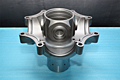
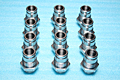
At Pacific Magnetic & Penetrant Co., Inc., we provide chemical processing, including passivation, etching, and cleaning for the aerospace and commercial industries. Nitric acid passivation, nitric/hydrofluoric acid etching, and nitric/hydrofluoric/chromic acid etching processes are available for stainless steel, titanium, and aluminum alloys. Prior to treatment, chemical descaling, acid pickling, grit blasting, or other means as necessary prepare the metal substrate. Barrel or rack equipment can be used to provide the optimal processing method, depending on the geometry, size, and volume of parts.
We are NADCAP accredited and employ the following testing methods: high humidity, salt spray, and copper sulfate testing, to verify the corrosion resistance of treated components. The typical lead time for an order averages 2 to 3 days for passivation and chemical etching services, with expedited service available for rush orders. We provide pick-up and delivery to most areas for added customer convenience. For additional information about our passivation and chemical process services, see the table below, or contact us directly./Asset/passivation_services_large.jpg
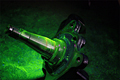
As part of our full service testing capabilities, at Pacific Magnetic & Penetrant Co., Inc., we offer magnetic particle inspection and liquid penetrant dye inspection for aerospace and other commercial manufacturing customers. Magnetic particle inspection can be used to detect discontinuities at the surface and near sub-surface of ferrous materials. These discontinuities may be a result of production errors or in-service damage. Prior to magnetic particle inspection, parts are thoroughly cleaned and dried to remove any scale, oil, or other contaminants that could interfere with testing. Once the part is properly prepared, a magnetic field is applied. When the magnetic field reaches any discontinuity, what is called "leakage" occurs. Magnetic particles are applied to the surface of the test part and congregate near any leakage area, visually identifying points of indications. When performed by certified professionals, magnetic particle inspection is a fast, accurate and relatively low cost way to identify flaws in ferromagnetic components.
While magnetic particle inspection can only be used in the testing of ferromagnetic parts, liquid penetrant inspection is capable of detecting surface indications in nearly any smooth, nonporous material. In liquid penetrant inspection, the part is thoroughly cleaned and or etched of all residue and contamination to provide a clear path for the liquid to reach any surface discontinuity. Once clean and or etched, liquid penetrant is applied to the part. Depending on the penetrant and material, the time required for the penetrant to seep into the surface indications will vary. After the specified time, the excess liquid is removed from the surface, leaving only the penetrant that leached into the surface indications. A developer is applied which pulls the penetrant out of the surface indications, making the surface flaws visible. We perform liquid penetrant inspection on titanium, aluminum, plastic, and composite parts. This testing service is available with lead times of 2 to 3 days, with rush service available as needed. For additional information about our magnetic particle and liquid penetrant testing capabilities, see the table below, or contact us directly./Asset/magnetic_particle_liquid_large.jpg
Chemical cleaning and surface preparation are key elements of many testing processes. At Pacific Magnetic & Penetrant Co., Inc., we specialize in materials testing, and offer an extensive array of chemical cleaning and surface preparation capabilities, including media blasting, acid pickling, chemical descaling, and aqueous parts washing. These processes may be performed as an independent service, or in conjunction with one of our chemical processing and non-destructive testing options. Media blasting capabilities include glass bead blasting and aluminum oxide blasting. Aluminum oxide is an angular media that is very aggressive in the removal of heavy scale, coatings, or rust. Due to its efficiency, aluminum oxide is an excellent multi-purpose abrasive that is very cost effective for applications in which its aggressive nature is a good fit. For more sensitive applications, glass beads are typically the preferred blasting media. Glass beads provide a smoother and brighter finish compared to angular abrasives, which makes them an ideal choice for precision finishing requirements.
Chemical descaling methods can be used to remove mineral scale, greases, and oils while acid pickling is available for removing oxides from the metal surface. Combined, all of the chemical cleaning and surface preparation methods represent a comprehensive solution for any metal cleaning application in the aerospace, commercial, and consumer goods industries. We specialize in small to medium volume projects and provide fast turnarounds, which average 2 to 3 days. Area-wide pickup and delivery, as well as expedited services, are available as needed. For additional information about our chemical cleaning and surface preparation capabilities, see the table below, or contact us directly./Asset/chemical_cleaning_surface_preparation_large.jpg
At Pacific Magnetic & Penetrant Co., Inc. (PMP), we were recently approached by a Prime Aerospace Contractor to help solve a problem they were having with their missile ordinance fuel cell. They had identified contamination that was located on the interior welds, and needed a solution to rectify the problem. Since the fuel cells where fully assembled, the challenge was to remove the contamination without destroying the integrity of the cells.
For this project, we utilized a NADCAP approved test procedure to help identify the contamination. Test procedure PMP QCM-515 was used along with a borescope with a white light attachment to visually examine the affected area. Once identified, we applied a copper sulfate corrosion test, which allowed us to accurately locate the areas of contamination.
After reviewing the prime contractor’s manufacturing planning, we determined that one of the steps in the planning was causing the contamination.
The client supplied us with coupons of the same material. After they welded the coupons, we ran several trial runs; the first one was using their planning so we could establish our base line. After identifying which step caused the contamination, the planning was re-written, eliminating the steps that ultimately caused the corrosion.
Not only did we show that the process would work on newly manufactured hardware, we showed it could be used to clean the contamination on the existing hardware without any parts being scrapped. The prime was very pleased with the results and awarded us with a contract to use our process on their parts for the next five years.
At Pacific Magnetic & Penetrant Co., we want to become part of your planning, and thus provide you with the advantages of our teamwork, expertise, quality, and on time delivery that have built our reputation as a trusted provider of testing services. Call or contact us anytime for further information./Asset/header_logo.jpg